
Wind Chill Calculator
Calculate the feels-like temperature from air temperature and wind speed
Real-Life Guide to Using the Wind Chill Calculator
Feels-like temperature in wind. Use the examples and checks below to turn the number into a practical decision.
When this calculator is useful
Relevant for outdoor workers, trekkers, or hill-station travelers in India checking how cold it will actually feel during windy winter conditions in places like Manali, Leh, or Shimla, where wind sharply amplifies the cold.
For most people, the best way to use the Wind Chill Calculator is to try the real case first, then change one input at a time. That makes the trade-off visible. For example, with a loan calculator you can change tenure while keeping the same rate; with an investment calculator you can change return assumption while keeping the same monthly contribution; with a health, education or measurement calculator you can check how much one input changes the final category.
The result should answer a practical question: Can I afford this? How much should I save? Is this score enough? Is this measurement within range? What is the safer or cheaper option? If the output does not answer the decision clearly, adjust the inputs until the scenario matches your real situation.
Practical Advice
Use the Wind Chill Calculator as a planning tool, not just a number generator. Write down the inputs you used, because the final answer is meaningful only when you remember the assumptions behind it.
If the decision affects money, health, tax, safety, academics or legal compliance, keep a second check ready. That second check may be a bank quote, payslip, official rule, prescription, site measurement, mark sheet or invoice.
Common Mistakes
- Applying wind chill calculations to temperatures above roughly 10°C (50°F) — the NWS wind chill formula is only valid and meaningful below this threshold, since wind doesn't meaningfully cool skin in mild weather.
- Applying wind chill in bright sunshine without adjustment — the standard formula assumes overcast, calm-sun conditions, so actual felt temperature in direct sun can be a few degrees warmer than the calculated value.
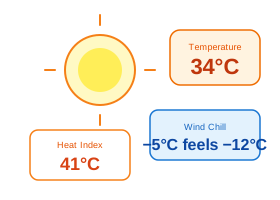
- Confusing wind chill with heat index — wind chill measures how much COLDER it feels due to wind, while heat index measures how much HOTTER it feels due to humidity; they apply to opposite ends of the temperature scale.
- Entering wind speed measured at a different height than the standard 10-meter reference height used in the formula, which can understate or overstate the true chill effect.
- Ignoring wind chill entirely when planning high-altitude treks, where even a moderate breeze at 5°C ambient temperature can create a felt temperature of -5°C or lower, raising frostbite risk.
How to Interpret Results
The wind chill value is the temperature that still air would need to be to produce the same rate of heat loss from exposed skin — a wind chill of -10°C means your skin loses heat as fast as it would in perfectly calm -10°C air, even though the thermometer might read a milder 2°C.
A good interpretation looks at both the main result and the supporting values. If a page shows totals, ratios, categories, schedules or warnings, read those together instead of focusing only on the biggest number.
Wind Chill Calculator FAQs
Useful answers for interpreting the output, avoiding mistakes and using the result responsibly.
What is Wind Chill?
Wind chill is the perceived decrease in air temperature felt by the human body due to wind. Moving air speeds up heat loss from exposed skin through convection. The stronger the wind, the faster warm air near the skin is replaced by cold air, making it feel colder.
The formula used here is the 2001 Joint Action Group for Temperature Indices (JAG/TI) standard: WC = 13.12 + 0.6215T − 11.37V⁰·¹⁶ + 0.3965T×V⁰·¹⁶ (T in °C, V in km/h). At −40°C with 60 km/h winds, frostbite can occur in under 10 minutes.