
CGPA to Percentage Calculator
Convert CGPA to percentage — supports 10-point AICTE, 4-point GPA, 7-point, and custom scales
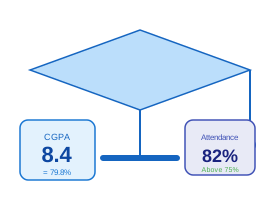
| CGPA | Percentage | Grade |
|---|---|---|
| 10.0 | 95.0% | O (Outstanding) |
| 9.0 | 85.5% | A+ (Excellent) |
| 8.5 | 80.75% | A (Very Good) |
| 8.0 | 76.0% | A (First Class) |
| 7.5 | 71.25% | B+ (Good) |
| 7.0 | 66.5% | B (Second Class) |
| 6.0 | 57.0% | C (Pass) |
| 5.0 | 47.5% | D (Below Pass) |
Real-Life Guide to Using the CGPA to Percentage
Convert CGPA to percentage marks. Use the examples and checks below to turn the number into a practical decision.
When this calculator is useful
Reach for this when a form, job application, or scholarship portal asks for "percentage" but your marksheet only shows a CGPA — typical for engineering, polytechnic, and CBSE-pattern degree students moving between a 10-point grading system and a percentage-based requirement.
For most people, the best way to use the CGPA to Percentage is to try the real case first, then change one input at a time. That makes the trade-off visible. For example, with a loan calculator you can change tenure while keeping the same rate; with an investment calculator you can change return assumption while keeping the same monthly contribution; with a health, education or measurement calculator you can check how much one input changes the final category.
The result should answer a practical question: Can I afford this? How much should I save? Is this score enough? Is this measurement within range? What is the safer or cheaper option? If the output does not answer the decision clearly, adjust the inputs until the scenario matches your real situation.
Practical Advice
Use the CGPA to Percentage as a planning tool, not just a number generator. Write down the inputs you used, because the final answer is meaningful only when you remember the assumptions behind it.
If the decision affects money, health, tax, safety, academics or legal compliance, keep a second check ready. That second check may be a bank quote, payslip, official rule, prescription, site measurement, mark sheet or invoice.
Common Mistakes
- Applying the CBSE-origin 9.5 multiplier to every university's CGPA — Anna University, for instance, publishes its own formula, Percentage = (CGPA − 0.5) × 10, which gives a different number for the same CGPA.
- Rounding the CGPA first (say, treating 8.47 as 8.5) before multiplying, which can shift the resulting percentage by half a point or more.
- Converting SGPA (one semester) instead of CGPA (all semesters combined) because the two numbers sit on the same 10-point scale and look interchangeable.
- Feeding in a US-style 4.0-scale GPA and multiplying it by 9.5 as if it were a 10-point CGPA, producing a meaningless result.
- Treating the converted figure as the "official" percentage for government job forms or GATE/PSU eligibility, when many of these bodies require the percentage exactly as printed on the consolidated marksheet or an institution-issued equivalence certificate.
How to Interpret Results
Multiply your CGPA by the conversion factor your own university/board actually publishes — the calculator shows the widely-used 9.5 figure alongside the result so you can sanity-check it against your institution's circular before submitting it anywhere official.
A good interpretation looks at both the main result and the supporting values. If a page shows totals, ratios, categories, schedules or warnings, read those together instead of focusing only on the biggest number.
CGPA to Percentage FAQs
Useful answers for interpreting the output, avoiding mistakes and using the result responsibly.
What is a CGPA to Percentage Calculator?
CGPA (Cumulative Grade Point Average) is the grading system used by most Indian universities. Converting CGPA to percentage helps students understand their academic performance in a familiar format and is often required for job applications, higher studies, and competitive exams.
Different universities use different scales — the most common in India is the 10-point AICTE scale where Percentage = CGPA × 9.5. US-style 4-point GPA and custom scales are also supported.
help_outlineHow to Use the CGPA to Percentage Calculator
- Select your CGPA scale from the dropdown — 10-point (AICTE, Anna University, VTU), 4-point GPA (US / many universities), 7-point, or Custom.
- If you select Custom, an extra field appears — enter the maximum CGPA possible on your scale (e.g., 5 for a 5-point scale).
- Enter your CGPA value in the "Your CGPA" field — use decimals as needed (e.g., 8.52).
- Results update live as you type — equivalent percentage and grade classification are shown instantly.
- Review the CGPA reference table to benchmark your score against common grade classifications on the 10-point AICTE scale.
Benefits
- Supports all major Indian scales — 10-point AICTE, 7-point, and custom in one tool
- Grade classification alongside percentage — O, A+, A, B+, B, C, D for instant context
- 4-point GPA conversion for students applying to foreign universities or US programmes
- Reference table for common CGPA values — benchmark your performance at a glance
- Useful for job applications, MBA/MS applications, and competitive exam eligibility verification
Key Terms
- CGPA
- Cumulative Grade Point Average — weighted average of grade points earned across all semesters
- AICTE Formula
- Percentage = CGPA × 9.5; applicable to 10-point scales used by most engineering colleges in India
- Grade Point
- Numeric value for each letter grade (O=10, A+=9, A=8, B+=7, B=6... on a 10-point scale)
- SGPA
- Semester GPA — computed for one semester; CGPA is the running cumulative average of all SGPAs
- Grade Classification
- Performance band: Outstanding (O ≥9.5), Excellent (A+ ≥9.0), Very Good (A ≥8.5), Good (B+ ≥7.5), etc.