
Force Calculator
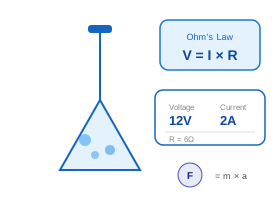
Solve for force, mass, or acceleration using Newton's Second Law (F = ma)
Real-Life Guide to Using the Force Calculator
F = ma force calculator. Use the examples and checks below to turn the number into a practical decision.
When this calculator is useful
Useful when you know an object's mass and how quickly it needs to accelerate (or decelerate) and want the net force required, such as sizing a motor, estimating braking force, or checking a physics problem.
For most people, the best way to use the Force Calculator is to try the real case first, then change one input at a time. That makes the trade-off visible. For example, with a loan calculator you can change tenure while keeping the same rate; with an investment calculator you can change return assumption while keeping the same monthly contribution; with a health, education or measurement calculator you can check how much one input changes the final category.
The result should answer a practical question: Can I afford this? How much should I save? Is this score enough? Is this measurement within range? What is the safer or cheaper option? If the output does not answer the decision clearly, adjust the inputs until the scenario matches your real situation.
Practical Advice
Use the Force Calculator as a planning tool, not just a number generator. Write down the inputs you used, because the final answer is meaningful only when you remember the assumptions behind it.
If the decision affects money, health, tax, safety, academics or legal compliance, keep a second check ready. That second check may be a bank quote, payslip, official rule, prescription, site measurement, mark sheet or invoice.
Common Mistakes
- Entering mass in grams instead of kilograms — a 500 g weight typed in as '500' instead of '0.5' produces a force 1000 times too large.
- Confusing weight (a force, measured in newtons) with mass (measured in kilograms), then feeding a weight value into the mass field.
- Forgetting that calculating the weight of an object requires multiplying mass by g = 9.8 m/s², while calculating force for horizontal motion needs the actual acceleration of the motion, not gravity.
- Ignoring sign conventions when several forces act at once, so a braking force and a driving force end up added instead of subtracted.
- Typing acceleration in km/h per second or some other non-SI unit instead of converting to m/s² first.
How to Interpret Results
The result is the net force in newtons (N); as a sanity check, remember 1 kgf ≈ 9.8 N, so a 10 kg object resting under gravity alone should show close to 98 N.
A good interpretation looks at both the main result and the supporting values. If a page shows totals, ratios, categories, schedules or warnings, read those together instead of focusing only on the biggest number.
Force Calculator FAQs
Useful answers for interpreting the output, avoiding mistakes and using the result responsibly.
Newton's Second Law
Newton's Second Law states that the net force acting on an object equals its mass times acceleration (F = ma). Force is measured in Newtons (N), where 1 N = 1 kg·m/s². Weight is a special case: the gravitational force on an object (W = mg).
On Earth, g = 9.81 m/s². A 70 kg person weighs 686.7 N (about 154.5 lbf). On the Moon (g = 1.62 m/s²), the same person weighs only 113.4 N. Mass is constant everywhere; weight changes with gravity.