
child_care

SSY Calculator

Plan your daughter's future with Sukanya Samriddhi Yojana — India's top tax-free girl child savings scheme
edit_calendar Last updated: Jul 22, 2026 | verified Reviewed by Calkulator Team | timer 2 min read
Investment illustration
Investment

Save for your daughter's future with Sukanya Samriddhi Yojana

SSY offers 8.2% interest with Section 80C benefits and completely tax-free maturity. Opened for girls below 10 years, deposits are required for 15 years, but the account matures at 21 years — ideal for education or marriage planning.

tips_and_updates Deposit the full ₹1.5 lakh/year in the first 15 years — the longer the money compounds, the larger the maturity value.
tuneSSY Details
Annual Investment
≈ 50 Thousand (Max ₹1.5L/yr)
Girl's Current Age
Yrs
0 yr10 yrs
Interest Rate
% p.a.
7%10%
Maturity Amount (Tax-Free)
At girl's age 21
Total Interest Earned
100% tax-free (EEE)
Total Investment
Over 15 deposit years
Interest Earned
Tax-free returns
Deposit Period
15 Years
Active contribution period
Maturity Age
21 Yrs
Girl's age at maturity
Returns
�%
Total Invested
Interest Earned

functions SSY Formula

Balance = (B_prev + Deposit) — (1 + r)

Deposits: 15 years | Matures at girl's age 21

EEE Status: 80C + Tax-free interest + Tax-free maturity

insights
Live Result Illustration
Visual summary — updates instantly as you enter values above
LIVE
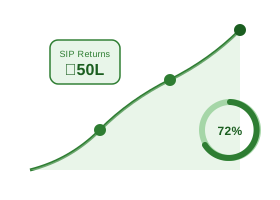
Investment Growth Summary Enter values above to update Invested ₹18 L Amount Total Corpus ₹50.5 L Maturity Total Gains ₹32.5 L Returns on Investment +180% Start early — 5 extra years can nearly double your corpus through the power of compounding.
tips_and_updates

Real-Life Guide to Using the SSY Calculator

Sukanya Samriddhi Yojana. Use the examples and checks below to turn the number into a practical decision.

When this calculator is useful

Parents or legal guardians of a girl child under 10 who want to project how much a Sukanya Samriddhi account will be worth when she turns 21, or work out the yearly deposit needed to hit a target corpus for her education or marriage.

For most people, the best way to use the SSY Calculator is to try the real case first, then change one input at a time. That makes the trade-off visible. For example, with a loan calculator you can change tenure while keeping the same rate; with an investment calculator you can change return assumption while keeping the same monthly contribution; with a health, education or measurement calculator you can check how much one input changes the final category.

The result should answer a practical question: Can I afford this? How much should I save? Is this score enough? Is this measurement within range? What is the safer or cheaper option? If the output does not answer the decision clearly, adjust the inputs until the scenario matches your real situation.

lightbulb Real-Life Example
Newborn daughter's education fund: Parents open an SSY account for their 1-year-old daughter and deposit ₹1,00,000 every year for 15 years.
1At an illustrative 8.2% p.a. (verify the current government-notified SSY rate, revised quarterly), ₹1,00,000 deposited annually for 15 years, with interest continuing to accrue untouched until she turns 21, grows to a maturity value of roughly ₹46-48 lakh.
2Now change one input, such as rate, time, quantity, unit or score, and compare the new result with the first one.
Because interest keeps compounding for 6 years after the last deposit, opening the account as early as possible matters more than the exact amount deposited each year.

Practical Advice

Use the SSY Calculator as a planning tool, not just a number generator. Write down the inputs you used, because the final answer is meaningful only when you remember the assumptions behind it.

If the decision affects money, health, tax, safety, academics or legal compliance, keep a second check ready. That second check may be a bank quote, payslip, official rule, prescription, site measurement, mark sheet or invoice.

Common Mistakes

  • Trying to open the account after the girl child turns 10, which is not permitted, so the calculator's tenure assumptions will not apply to such cases.
  • Assuming deposits are required for the entire 21-year tenure — contributions are mandatory only for the first 15 years, after which the balance simply continues earning interest until maturity.
  • Depositing less than ₹250 in a financial year, which makes the account irregular and can require a small penalty payment to reactivate it.
  • Overlooking the two-accounts-per-family rule (with an exception for twins or triplets), which can affect eligibility for a third daughter's account if not structured correctly.
  • Not modeling the partial withdrawal permitted at age 18 for higher education (up to 50% of the previous year-end balance), which lowers the base the calculator assumes will keep compounding until age 21.

How to Interpret Results

The maturity figure assumes deposits are made every year for the first 15 years and the account is left untouched until the girl turns 21 — if a partial withdrawal is made at 18 for education expenses, the actual maturity balance will be lower than the calculator's headline number.

A good interpretation looks at both the main result and the supporting values. If a page shows totals, ratios, categories, schedules or warnings, read those together instead of focusing only on the biggest number.

quiz

SSY Calculator FAQs

Useful answers for interpreting the output, avoiding mistakes and using the result responsibly.

How does the SSY calculator project the maturity amount for my daughter?
It compounds your annual deposits made during the first 15 years at the prevailing SSY rate, then continues compounding the accumulated balance without fresh deposits until the account matures when your daughter turns 21.
Do I have to keep depositing money for all 21 years?
No, deposits are only required for the first 15 years from account opening; after that, no further contribution is needed, though the balance keeps earning interest until maturity.
What is the minimum and maximum I can deposit each year?
The minimum is ₹250 per year and the maximum is ₹1.5 lakh per year, and deposits can be made in a lump sum or in multiple installments through the year.
Can I open an SSY account for more than two daughters?
Generally only two accounts are allowed per family, one per girl child, with an exception permitting a third account if the second or later delivery results in twins or triplets.
What happens if I withdraw money when my daughter turns 18?
She can withdraw up to 50% of the balance as it stood at the end of the previous financial year for higher education expenses, which reduces the amount left to compound for the remaining years until maturity.
Is the SSY maturity amount taxable?
No, SSY also follows the exempt-exempt-exempt structure, so contributions qualify for Section 80C deduction, interest is tax-free, and the maturity amount is fully tax-free.
What if I miss a yearly deposit — does the account close?
The account does not close but becomes a "default account," which can be revived by paying the minimum due deposits along with a small penalty for each missed year.
Can the account be transferred if we move cities?
Yes, an SSY account can be transferred between authorised banks or post offices anywhere in India free of cost when the family relocates.

SSY — India's Best Tax-Free Scheme for Girl Children

Sukanya Samriddhi Yojana (SSY) is a government savings scheme specifically for girl children below 10 years of age. At 8.2% p.a. compounded annually, it is one of the highest-yielding small savings schemes — and has EEE tax status.

Deposits are allowed for 15 years from account opening. The account matures when the girl turns 21. The entire maturity amount is fully tax-free. A 50% partial withdrawal is allowed at age 18 for higher education.

lightbulb Example Calculation
Scenario: ₹50,000/year at 8.2%, girl age 3
1Deposit for 15 years (until age 18)
2Account earns interest till age 21
3Total invested: ₹7.5L → Matures to ~₹26L+
✓ 3.5� return, 100% tax-free — ideal for education & marriage fund
live_help

Frequently Asked Questions

SSY — India's girl child savings scheme explained

Is the SSY interest rate fixed or does it change over time?
The SSY rate is reviewed quarterly by the Ministry of Finance. Unlike SCSS (where the rate is locked at account opening), the SSY rate is NOT locked — it changes for all existing accounts when revised. Historically (2015�2025), SSY rates have ranged from 7.6% to 9.2%, consistently higher than PPF.
What is the EEE tax benefit of SSY?
SSY has full EEE status: (E1) Annual deposits up to ₹1.5L qualify for Section 80C deduction; (E2) Interest accrued each year is completely exempt under Section 10; (E3) The maturity amount at age 21 is fully tax-free. No TDS on SSY interest or maturity. This triple exemption makes SSY the most tax-efficient long-term savings instrument available.
How does SSY compare to PPF for a girl child's savings?
Both are government-backed EEE instruments. SSY rate 8.2% vs PPF 7.1% — SSY is higher. SSY: only for girl children below 10; PPF: open to all. SSY matures at girl's age 21; PPF at 15 years from opening. SSY does not allow loans; PPF allows loans from year 3. For a girl child's education and marriage fund, SSY is generally preferred due to higher rate and purpose-specific design.
keyboard_arrow_up