
grade

SGPA Calculator

Calculate Semester Grade Point Average (SGPA) using CBCS 10-point scale with percentage conversion
edit_calendar Last updated: Jul 22, 2026 | verified Reviewed by Calkulator Team | timer 2 min read
Education illustration
Education

Calculate your semester GPA from subject grades and credits

SGPA is the weighted average of grade points, where each subject contributes according to its credit hours. A subject with 4 credits and grade A (9 points) contributes more than a 2-credit subject with the same grade.

tips_and_updates Focus extra effort on high-credit subjects — they have the biggest impact on your SGPA.
Subject Details
CBCS Grading (10-point)
O=10   A+=9   A=8   B+=7   B=6   C=5   P=4   F=0
SGPA = Σ(Credits × Grade Points) / Σ Credits
Percentage = SGPA × 9.5
Cumulative CGPA (Optional)
Add previous semester SGPAs to compute overall CGPA
SGPA
Equivalent %
SGPA × 9.5
Total Credits
Grade
Description
Total Grade Points
Pass / Fail
Subject-wise Breakdown
Subject Credits Grade GP Earned
insights
Live Result Illustration
Visual summary — updates instantly as you enter values above
LIVE
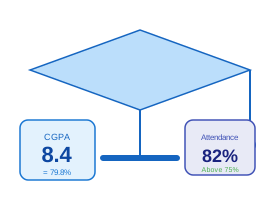
Academic Score Indicator Updates in real-time 77.5% Min 75% Your Score 77.5% Grade B+ Status Passing Need to attend or score more? Use the calc above.
tips_and_updates

Real-Life Guide to Using the SGPA Calculator

Semester GPA from subject grades. Use the examples and checks below to turn the number into a practical decision.

When this calculator is useful

Use this right after a semester's results are declared, when your marksheet lists individual subject grades and credits but not the combined semester GPA — common across AICTE/UGC-affiliated engineering and degree colleges running a credit system.

For most people, the best way to use the SGPA Calculator is to try the real case first, then change one input at a time. That makes the trade-off visible. For example, with a loan calculator you can change tenure while keeping the same rate; with an investment calculator you can change return assumption while keeping the same monthly contribution; with a health, education or measurement calculator you can check how much one input changes the final category.

The result should answer a practical question: Can I afford this? How much should I save? Is this score enough? Is this measurement within range? What is the safer or cheaper option? If the output does not answer the decision clearly, adjust the inputs until the scenario matches your real situation.

lightbulb Real-Life Example
Five subjects with unequal credit loads: An engineering student's semester has Maths (4 credits, grade A = 8), Physics (4 credits, B+ = 7), a Lab (2 credits, O = 10), an Elective (3 credits, A = 8), and a Seminar (1 credit, B = 6).
1Total credit points = (4×8) + (4×7) + (2×10) + (3×8) + (1×6) = 32 + 28 + 20 + 24 + 6 = 110. Total credits = 4+4+2+3+1 = 14. SGPA = 110 ÷ 14 = 7.86.
2Now change one input, such as rate, time, quantity, unit or score, and compare the new result with the first one.
A high grade in a 1-credit seminar barely moves the SGPA, while the 4-credit subjects dominate the outcome — credit weight matters more than the number of subjects.

Practical Advice

Use the SGPA Calculator as a planning tool, not just a number generator. Write down the inputs you used, because the final answer is meaningful only when you remember the assumptions behind it.

If the decision affects money, health, tax, safety, academics or legal compliance, keep a second check ready. That second check may be a bank quote, payslip, official rule, prescription, site measurement, mark sheet or invoice.

Common Mistakes

  • Averaging the grade points as a simple mean (adding them and dividing by the number of subjects) instead of weighting each by its credit hours — a 1-credit lab and a 4-credit core subject do not count equally.
  • Entering raw marks or percentage for a subject instead of converting to the grade point on the applicable 10-point scale (O=10, A+=9, A=8, B+=7, B=6, C=5, P=4, F=0).
  • Leaving out a backlog or failed subject from the calculation entirely, when most universities require it to be included with its 0 (or applicable) grade point until cleared.
  • Mixing grade-point boundaries from different universities — the marks range that earns an "A" at AKTU is not the same range that earns an "A" under Anna University's or VTU's scheme.
  • Confusing this semester-level SGPA with CGPA — SGPA reflects one semester only, and averaging several SGPAs by simple mean (instead of by total credits across semesters) gives an inaccurate CGPA.

How to Interpret Results

The result is your credit-weighted average grade point for that one semester only — compare it against your college's minimum SGPA requirement to avoid probation, and remember your CGPA is a separate credit-weighted average across all semesters, not an average of SGPAs.

A good interpretation looks at both the main result and the supporting values. If a page shows totals, ratios, categories, schedules or warnings, read those together instead of focusing only on the biggest number.

quiz

SGPA Calculator FAQs

Useful answers for interpreting the output, avoiding mistakes and using the result responsibly.

What is SGPA and how is it different from CGPA?
SGPA (Semester Grade Point Average) is the credit-weighted average of grade points earned in one semester only. CGPA is the credit-weighted average across all semesters completed so far, and is a separate calculation, not a simple average of SGPAs.
What formula does this calculator use?
SGPA = (sum of credit × grade point for each subject) ÷ (sum of credits), following the standard AICTE/UGC-style weighted formula used by most Indian engineering and degree colleges.
The grade point scale my college uses looks different from the 10-point one here — what should I do?
Grade point boundaries vary by university (for example, the marks range for an "A" grade differs between AKTU, VTU, and Anna University). Use your own institution's official grade-point table for the inputs, since the formula for combining them stays the same even when boundaries differ.
Do I include a failed or backlog subject in the SGPA calculation?
Most universities require a failed subject to be included with its grade point (usually 0) and its full credit weight until it is cleared, so it does pull the SGPA down — check your own university's examination manual to confirm.
Why does my calculated SGPA not match the number printed on my official marksheet?
This is usually a rounding difference or a grade-point table mismatch — double check that the grade points you entered match exactly what your university's scheme assigns to each letter grade, and that all credits (including labs and seminars) are included.
Can SGPA be used directly for job applications instead of CGPA?
Employers and further-study applications almost always ask for cumulative CGPA rather than a single semester's SGPA, since SGPA only reflects one term's performance and can be affected by a single tough semester.
What if I have an elective with a non-standard credit value, like 0.5 or 1.5?
The weighted formula works the same regardless of the credit value — just enter the exact credit weight assigned to that course by your syllabus, since even fractional credits are multiplied by the grade point in the same way.
How do I go from this semester's SGPA to my overall CGPA?
You need the SGPA and total credits of every semester completed so far, then apply the same weighted-average formula across all of them combined — a single semester's SGPA alone can't tell you your CGPA.

What is an SGPA Calculator?

SGPA (Semester Grade Point Average) represents academic performance for a single semester under the Choice-Based Credit System (CBCS) used by most Indian universities. It is calculated by dividing the sum of (credit × grade point) for all subjects by total credits earned that semester.

SGPA is then used to calculate CGPA across all semesters. Converting SGPA to percentage (SGPA × 9.5 for 10-point scale) gives an approximate equivalent percentage for use in applications and resumes.

lightbulb Example Calculation
Scenario: Priya Krishnan, 2nd year B.Tech student at NIT Trichy — Semester 3 results: Physics (4 cr, O=10), Maths (4 cr, A+=9), Chemistry (3 cr, A=8), Programming (4 cr, O=10), English (2 cr, A+=9)
1Weighted sum = (4×10) + (4×9) + (3×8) = 40+36+24 = 100
2Total credits = 4 + 4 + 3 = 11
3SGPA = 100 / 11 = 9.09 → Percentage ≈ 86.36%
✓ Result: SGPA 9.09 — Outstanding (O Grade)

help_outlineHow to Use the SGPA Calculator

  1. Select the total number of subjects for this semester from the dropdown — options range from 2 to 8 subjects.
  2. For each subject, enter the subject name, select the credit value, and choose the letter grade (O, A+, A, B+, B, C, P, F) from the dropdown.
  3. Results update live as you change grades and credits — SGPA and the equivalent percentage (SGPA × 9.5) are shown with a subject-wise grade points breakdown.
  4. To compute cumulative CGPA: enter previous semester SGPAs and credit counts in the Cumulative CGPA section below, then click "Calc CGPA."
  5. Review pass/fail status — SGPA ≥ 4 (P grade equivalent) is required to avoid academic probation in most universities.

Benefits

  • CBCS 10-point grading scale (O=10 through F=0) — covers all UGC-affiliated Indian universities
  • SGPA to percentage conversion shown automatically (SGPA × 9.5)
  • Cumulative CGPA calculator built in — add past semesters' SGPAs for overall CGPA in one tool
  • Subject-wise grade points table shows each subject's contribution to SGPA
  • Plan target SGPA before results — use expected grades to project semester outcome

Key Terms

SGPA
Semester Grade Point Average = Σ(Credit × Grade Points) / Σ Credits; academic performance for one semester
CBCS
Choice-Based Credit System — UGC-mandated grading framework adopted by most Indian universities
Grade Points
Numeric values: O=10, A+=9, A=8, B+=7, B=6, C=5, P=4, F=0 (on 10-point scale)
CGPA
Cumulative GPA = Σ(SGPA × Semester Credits) / Σ(All Credits) — the running average across all semesters
Equivalent Percentage
SGPA × 9.5 — AICTE formula for converting SGPA to traditional percentage for applications and resumes

quizFrequently Asked Questions

What is the difference between SGPA and CGPA?
SGPA (Semester GPA) is calculated fresh each semester from only that semester's subjects and credits. CGPA (Cumulative GPA) is the running weighted average of all completed semester SGPAs, with each semester's SGPA weighted by its total credits. A single great semester improves SGPA substantially but has a diminishing impact on CGPA as more semesters accumulate. CGPA is what appears on your final degree and is used by employers and graduate school admission committees.
How is SGPA converted to percentage?
The standard AICTE-recommended formula is: Percentage = SGPA × 9.5. Example: SGPA 8.0 → 8.0 × 9.5 = 76%. This formula is not universal — some universities use different multipliers (e.g., Anna University uses specific lookup tables; Mumbai University may use different factors for different programmes). Always verify with your university's official academic regulations or the equivalency certificate issued by the registrar, especially for job applications specifying minimum percentage requirements.
What happens if I score an F grade in a subject?
An F grade assigns 0 grade points for that subject, but the credits still count in the SGPA denominator — this significantly lowers SGPA. Example: scoring F in a 4-credit subject in an 18-credit semester adds 0 to the numerator but 4 to the denominator, pulling SGPA toward zero by 4 units. You must clear the subject in a supplementary (back-paper) examination. Most universities allow repeated attempts but cap the replacement grade at B or P, and flag it on the transcript as a repeat attempt.
Is SGPA ≥ 4 required to pass the semester?
Under UGC-CBCS guidelines, P (Pass) grade requires a grade point of 4 or above. An SGPA below 4 indicates the student has failed one or more subjects. However, the specific pass rule varies by institution: some require passing every individual subject; others allow carrying one or two failed subjects to the next semester with conditional promotion; some use a minimum SGPA threshold for promotion. Always refer to your university's specific academic regulations — this calculator shows the SGPA and flags pass/fail based on the P-grade threshold.
How do I plan my CGPA target using this calculator?
Use the "what-if" approach: enter expected grades for current semester subjects to see the projected SGPA. Then enter past semester SGPAs and their credit totals in the Cumulative CGPA section — the tool computes your projected CGPA assuming your expected SGPA for the current semester. Work backward: if you need a CGPA of 8.0 by end of 8th semester and currently have CGPA 7.5 after 6 semesters, calculate what SGPA is required in semesters 7 and 8 to bridge that gap.
keyboard_arrow_up