
gavel

Estate Calculator

Estimate net estate value and what passes to heirs after liabilities and costs
edit_calendar Last updated: Jul 22, 2026 | verified Reviewed by Calkulator Team | timer 2 min read
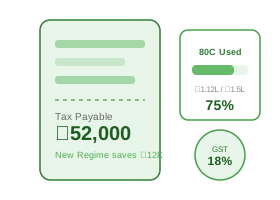
Tax illustration
Tax

Estimate inheritance costs and legal fees

While India does not currently levy an estate or inheritance tax, legal costs for succession certificates, probate, and property mutation can be 2-5% of estate value. Plan these costs to avoid surprises for your family.

tips_and_updates A registered will significantly reduces legal complexity and costs — get one drafted even if you are young.
Gross Estate Value (₹)
Total: property + investments + savings + life insurance + jewellery
Outstanding Liabilities (₹)
Home loans, personal loans, credit card dues
Legal & Admin Costs (%)
%
Probate fees, lawyer fees, registration costs (typically 1–3%)
Personal/Charitable Bequests (₹)
Amount willed to charity or specific individuals separately
Estate Summary
Gross Estate
Net Estate (after liabilities)
Legal & Admin Costs
Taxable / Distributable Estate
Value Passing to Heirs
insights
Live Result Illustration
Visual summary — updates instantly as you enter values above
LIVE
Salary & Tax Breakdown Updates in real-time Gross Income ₹10,00,000 Income Tax ₹2,00,000 20% PF + Deductions ₹83,000 Net Take-Home ₹7,17,000 71.7% Tip: Max out Section 80C (₹1.5L), HRA, and NPS contributions to legally reduce your tax outgo.
tips_and_updates

Real-Life Guide to Using the Estate Tax Calculator

Inheritance and estate tax estimate. Use the examples and checks below to turn the number into a practical decision.

When this calculator is useful

People planning inheritance or succession — either writing a will, dividing ancestral property, or receiving inherited assets — use this to understand the actual costs involved, since India has no estate duty today but several related taxes and fees still apply.

For most people, the best way to use the Estate Tax Calculator is to try the real case first, then change one input at a time. That makes the trade-off visible. For example, with a loan calculator you can change tenure while keeping the same rate; with an investment calculator you can change return assumption while keeping the same monthly contribution; with a health, education or measurement calculator you can check how much one input changes the final category.

The result should answer a practical question: Can I afford this? How much should I save? Is this score enough? Is this measurement within range? What is the safer or cheaper option? If the output does not answer the decision clearly, adjust the inputs until the scenario matches your real situation.

lightbulb Real-Life Example
Inherited flat later sold by heir: A father purchased a flat in 2005 for ₹15,00,000; his daughter inherits it in 2026 when its market value is ₹90,00,000, and she sells it the same year for ₹92,00,000.
1No tax is due at the point of inheritance itself. When she sells, her capital gain is computed using the father's original 2005 cost of ₹15,00,000 (adjusted for indexation up to the applicable cut-off rules), not the ₹90,00,000 value at inheritance, resulting in a long-term capital gain that could be well over ₹60,00,000 depending on indexation applied.
2Now change one input, such as rate, time, quantity, unit or score, and compare the new result with the first one.
Inheriting an asset is tax-free, but the tax bill effectively gets deferred to whenever the heir sells it, calculated on the original owner's cost — a much larger gain than if the cost basis reset to market value at inheritance.

Practical Advice

Use the Estate Tax Calculator as a planning tool, not just a number generator. Write down the inputs you used, because the final answer is meaningful only when you remember the assumptions behind it.

If the decision affects money, health, tax, safety, academics or legal compliance, keep a second check ready. That second check may be a bank quote, payslip, official rule, prescription, site measurement, mark sheet or invoice.

Common Mistakes

  • Assuming India has an inheritance or estate tax at all — estate duty was abolished in 1985, and this calculator instead estimates related costs like capital gains tax on eventual sale, probate/succession certificate fees, and stamp duty on transfer, not a direct tax on the inheritance itself
  • Believing inherited assets are taxed at the time of inheritance — receiving inherited property or money is not itself a taxable event for the inheritor
  • Forgetting that when an inherited asset is later sold, the cost of acquisition for capital gains purposes is the original owner's purchase cost and date, not the fair market value on the date of inheritance
  • Not budgeting for state-specific stamp duty and registration charges on transferring inherited immovable property into the legal heir's name, which can run into lakhs on a valuable property
  • Overlooking probate or succession certificate court fees, which are often calculated as a percentage of the estate value and can be substantial for larger estates

How to Interpret Results

The output is not a tax bill in the traditional sense but an estimate of the combined transfer-related costs (stamp duty, court/probate fees, and future capital gains exposure if the asset is sold) so you can plan for them ahead of an inheritance transfer.

A good interpretation looks at both the main result and the supporting values. If a page shows totals, ratios, categories, schedules or warnings, read those together instead of focusing only on the biggest number.

quiz

Estate Tax Calculator FAQs

Useful answers for interpreting the output, avoiding mistakes and using the result responsibly.

Does India actually have an estate or inheritance tax?
No. India abolished estate duty in 1985, so there is currently no tax levied specifically on inheriting property or wealth from a deceased person. This calculator instead estimates the practical costs — stamp duty, court fees, and future capital gains — that arise around inheritance and succession.
What does this calculator actually estimate then?
It estimates ancillary costs of transferring an inherited estate: stamp duty and registration charges for changing title of immovable property, probate or succession certificate court fees where applicable, and the potential capital gains tax the heir may owe if they eventually sell the inherited asset.
If I inherit money or property, do I need to report it as income in my ITR?
Money or property received by way of inheritance is specifically excluded from being treated as income and is not taxable when received; however, any income the inherited asset generates afterward, like rent or interest, is taxable in the inheritor's hands going forward, and needs to be reported in subsequent returns.
Why does the calculator ask for the original purchase price paid by the deceased?
Because when the inherited asset is eventually sold, capital gains are computed using the original owner's cost of acquisition and purchase date carried forward to the heir, not the market value on the date of inheritance — this materially affects the gain calculation and is a commonly misunderstood rule.
Do all states charge the same stamp duty for transferring inherited property?
No, stamp duty and registration charges for transmission of inherited property vary by state, and several states offer a reduced or nominal rate specifically for transfers to legal heirs compared to a regular sale transaction — check your specific state's stamp duty schedule rather than relying on a single national figure.
Is a will required to avoid these costs, or does it not matter?
Having a registered will can simplify and sometimes reduce the succession process cost since it may avoid the need for a succession certificate through court in some cases, though a will still typically needs probate in certain jurisdictions or for certain asset types; without a will, legal heirs usually need a succession certificate or legal heirship certificate, adding time and cost.
How does this differ from a gift received during someone's lifetime?
Gifts received from a relative (including parents) are also exempt from tax regardless of amount, similar to inheritance, but gifts from a non-relative above a threshold (illustratively ₹50,000 in aggregate per year) can be taxable in the recipient's hands under "income from other sources" — a distinction this estate-focused calculator does not cover.
What should heirs do practically after estimating these figures?
Use the estimate to budget for registration and legal fees before initiating the transfer, gather all original purchase documents of the deceased to correctly establish cost basis for any future sale, and consult a lawyer or CA for the specific succession process applicable to the asset type and state involved.

Estate Planning in India

India abolished the Estate Duty Act in 1985, so there is no estate or inheritance tax. However, heirs may have income tax liability on income generated from inherited assets, and capital gains tax applies on sale of inherited property. Proper estate planning through a valid Will, nomination, and trusts can minimise costs and disputes.

Key steps: write a registered Will, update nominations in bank/demat/insurance accounts, consider a family trust for large estates, and discuss with a CA or legal advisor about Gift Deed transfers during your lifetime to reduce estate complexity.

lightbulb Example
₹1 Cr estate, ₹20L liabilities, 2% legal:
1Net estate: ₹80 L
2Legal costs: ₹1.6 L → heirs get ₹78.4 L
✓ No estate tax in India since 1985

quizFrequently Asked Questions

Is there an estate tax or inheritance tax in India?
India abolished the Estate Duty Act in 1985, so there is currently no estate tax or inheritance tax. However, inherited assets are subject to capital gains tax when sold, with the cost basis stepped up to the deceased's original purchase price (or fair market value for assets acquired before April 2001). Legal heirs pay capital gains on the gain from that cost basis to the sale price.
What is the best way to transfer wealth to heirs in India?
Common methods: (1) Will — simple and inexpensive but goes through probate. (2) Gift during lifetime — gifts to specified relatives are tax-free; to others, amounts above ₹50,000 may be taxable. (3) Trust — manages assets across generations. (4) Joint ownership — property passes automatically on death. Consult a legal and tax advisor for estate planning.
What documents are needed to claim an inherited estate?
A legal heir needs: death certificate, succession certificate or probate from a civil court (if no will), legal heir certificate from the municipality or tehsildar's office, and the original will (if applicable). For bank accounts, most banks have simplified nominee and death claim procedures that bypass court for smaller amounts.
keyboard_arrow_up