
monitor_weight

Weight Converter

Convert weight between kg, lbs, stone, grams, ounces and tonnes instantly
edit_calendar Last updated: Jul 22, 2026 | verified Reviewed by Calkulator Team | timer 2 min read
Conversion illustration
Conversion

Convert weight between kg, pounds, stone, and more

Shopping online from the US? A 5-pound bag of protein powder is 2.27 kg. Checking a UK fitness plan? 12 stone is 76.2 kg. Enter any weight and see instant conversions across 7 common units.

tips_and_updates For quick kg to pounds conversion: double the kg value and add 10% — gives a close approximation.
Enter Weight
Value
#
From Unit
Quick Reference
1 kg= 2.205 lbs
1 lb= 453.6 g
1 stone= 6.35 kg = 14 lbs
1 oz= 28.35 g
1 tonne= 1,000 kg
All Conversions
Grams
Milligrams
Ounces
Stones
Metric Tonnes
insights
Live Result Illustration
Visual summary — updates instantly as you enter values above
LIVE
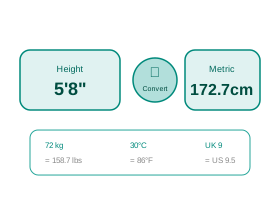
Unit Conversion Updates in real-time Input 5 ft 8 in Imperial Output 172.72 cm Metric Always round only after the full conversion is complete — early rounding causes measurement errors.
tips_and_updates

Real-Life Guide to Using the Weight Converter

kg, lbs, stones conversion. Use the examples and checks below to turn the number into a practical decision.

When this calculator is useful

Handy when an imported protein supplement, gym equipment spec, or UK/US medical report lists weight in pounds or stones and you need kilograms to match your Indian weighing scale, prescription, or diet plan.

For most people, the best way to use the Weight Converter is to try the real case first, then change one input at a time. That makes the trade-off visible. For example, with a loan calculator you can change tenure while keeping the same rate; with an investment calculator you can change return assumption while keeping the same monthly contribution; with a health, education or measurement calculator you can check how much one input changes the final category.

The result should answer a practical question: Can I afford this? How much should I save? Is this score enough? Is this measurement within range? What is the safer or cheaper option? If the output does not answer the decision clearly, adjust the inputs until the scenario matches your real situation.

lightbulb Real-Life Example
Reading a UK weight-loss article: Anjali reads a UK fitness article saying a healthy adult weight target is "11 stone" and wants to know what that means in kilograms for her own tracking.
111 stone × 14 lbs/stone = 154 lbs; 154 lbs ÷ 2.20462 = 69.85 kg, so "11 stone" is roughly 69.9 kg.
2Now change one input, such as rate, time, quantity, unit or score, and compare the new result with the first one.
Stones must first be converted to pounds before converting to kilograms — skipping the intermediate step is the most common source of stone-conversion errors.

Practical Advice

Use the Weight Converter as a planning tool, not just a number generator. Write down the inputs you used, because the final answer is meaningful only when you remember the assumptions behind it.

If the decision affects money, health, tax, safety, academics or legal compliance, keep a second check ready. That second check may be a bank quote, payslip, official rule, prescription, site measurement, mark sheet or invoice.

Common Mistakes

  • Forgetting that 1 stone is 14 lbs, not 10 or 16 — someone reading "11 stone 5" as roughly 115 lbs instead of the correct 159 lbs will be off by more than 25%.
  • Rounding 70 kg to "about 154 lbs" and then using that rounded figure for a precise dosage-per-kg medicine calculation instead of the exact 154.32 lbs.
  • Mixing up mass (kg) with force/weight in newtons — assuming a 70 kg person "weighs" 70 in some universal sense, when their weight in newtons (70 × 9.8 ≈ 686 N) is a different physical quantity used only in physics contexts.
  • Using an average conversion shortcut like "divide pounds by 2" instead of the correct factor of 2.20462 lbs per kg, which understates kilograms by nearly 10%.
  • Converting a baby's birth weight from pounds-and-ounces notation (e.g. 6 lbs 8 oz) by ignoring the ounces — treating it as 6 lbs flat instead of the correct 6.5 lbs (2.95 kg vs 2.72 kg, a meaningful difference for a newborn).

How to Interpret Results

Treat the kilogram figure as the one to record on Indian medical and fitness records, since doctors, pharmacies, and gyms in India almost universally work in kg; use pounds/stones only when directly communicating with a US or UK source document.

A good interpretation looks at both the main result and the supporting values. If a page shows totals, ratios, categories, schedules or warnings, read those together instead of focusing only on the biggest number.

quiz

Weight Converter FAQs

Useful answers for interpreting the output, avoiding mistakes and using the result responsibly.

What is the exact formula this calculator uses for kg to lbs?
It multiplies kilograms by 2.20462 to get pounds, and divides pounds by 2.20462 to get back to kilograms. For stones, it first converts stones to pounds (× 14), then applies the same kg/lbs factor.
Why do UK people measure body weight in stones instead of just pounds or kg?
Stones are a traditional British unit that predates widespread metrication, and body weight is one of the few contexts where the UK still commonly uses it in everyday speech, even though official UK medical records now typically use kilograms.
Is a US pound the same as an Indian or British pound in weight?
Yes, the pound as a unit of mass (avoirdupois pound = 453.59 grams) is standardized internationally and is the same in the US, UK, and any conversion done in India — there is no separate "Indian pound". Only currency uses different "pound" definitions, not weight.
How do I convert a weight given as "6 lbs 8 oz" for a newborn?
Convert the ounces to a fraction of a pound first (8 oz ÷ 16 = 0.5 lb), add it to the whole pounds (6 + 0.5 = 6.5 lbs), then apply the standard lbs-to-kg conversion (6.5 ÷ 2.20462 ≈ 2.95 kg).
Why does my bathroom scale in kg not match a US gym scale reading in lbs exactly?
If both scales are accurate, the underlying weight is identical and only the displayed unit differs; small mismatches usually come from scale calibration, clothing weight, or time-of-day water retention rather than a conversion error.
Does body weight in kg convert the same way as any other mass, like a parcel or luggage?
Yes, mass conversion factors are identical regardless of what is being weighed — a 20 kg suitcase and a 20 kg person both convert to the same 44.09 lbs, since the kg-to-lbs ratio doesn't depend on the object.
How accurate do I need to be when converting weight for medicine dosage?
For dosage calculations (commonly given as mg per kg of body weight), use the precise decimal kilogram figure rather than a rounded one, since dosage errors compound with weight rounding — always double-check drug dosing conversions with a pharmacist rather than relying solely on a converter.
What should I check if converting my weight gives a suspiciously round number?
A suspiciously round result (like exactly 70.0 kg from 154 lbs) usually means the original figure was already rounded before you converted it, not that the conversion introduced rounding — trace back to the original source measurement if precision matters.

Weight Units Around the World

  • kg (kilogram): SI standard unit. Used in India, most of the world, science, and medicine.
  • lb (pound): Used primarily in the USA. 1 lb = 0.4536 kg. Bodyweight in the US is expressed in lbs.
  • stone: Used in the UK and Ireland for bodyweight. 1 stone = 14 lbs = 6.35 kg. "She weighs 9 stone" = 57.2 kg.
  • oz (ounce): 1/16th of a pound = 28.35 g. Used in cooking (especially US recipes) and precious metals.
  • g / mg: Metric sub-units. Used in medicine, nutrition labels, and chemistry.
  • Metric tonne: 1,000 kg. Used in trade, shipping, and agriculture.

Common Conversions for India

Body weight
Indian passports and medical records use kg. Fitness apps sometimes show lbs. Quick mental conversion: multiply kg by 2.2 to get lbs (70 kg × 2.2 = 154 lbs).
US recipes
American recipes use oz and cups. 1 cup flour ≈ 120 g; 1 cup sugar ≈ 200 g; 1 oz ≈ 28 g. Convert to grams for kitchen scale use in India.
Gold & silver
Precious metals are quoted in troy ounces (31.1 g) globally. Indian gold is also quoted per 10 grams or per tola (11.66 g) locally.

quizFrequently Asked Questions

How do I convert kg to lbs and vice versa?
1 kg = 2.20462 lbs. To convert kg to lbs: multiply by 2.20462. To convert lbs to kg: divide by 2.20462. Quick mental math: 70 kg ≈ 154 lbs (multiply by 2.2); 150 lbs ≈ 68 kg (divide by 2.2). This calculator handles all weight unit conversions instantly with full precision.
What is the difference between mass and weight in everyday terms?
In common usage, "weight" means mass (how much matter an object contains, measured in kg or lbs). In physics, weight is the gravitational force on a mass (measured in Newtons). Your mass is the same on Earth and the Moon; your weight (gravitational pull) is 6× less on the Moon. A bathroom scale measures the gravitational force — proportional to your mass on Earth.
What are traditional Indian units of weight?
Tola (used in gold trading): 11.664 grams exactly. Seer: legally standardised at 1 kg (historically variable). Maund: 37.32 kg (referenced in commodities). Ratti: 0.1215 g (used in gems and jewellery). The Weights and Measures Act 1958 standardised SI units in India, but traditional units persist in local markets and jewellery shops.
keyboard_arrow_up