
height

Height Converter

Convert height between centimetres, metres, feet and inches instantly
edit_calendar Last updated: Jul 22, 2026 | verified Reviewed by Calkulator Team | timer 2 min read
Conversion illustration
Conversion

Convert height between feet-inches and centimetres

Medical forms in India use centimetres, while casual conversation uses feet and inches. 5 feet 8 inches = 172.72 cm. Switch between both systems instantly — useful for fitness apps, passport forms, and gym tracking.

tips_and_updates Standard door height in India is 6 feet 8 inches (203 cm) — a useful reference for estimating heights.
Conversion Direction
Height in Centimetres
cm
Quick Reference
cm ft & in m
1504′11.1″1.50
1555′1.0″1.55
1605′3.0″1.60
1655′5.0″1.65
1705′6.9″1.70
1755′8.9″1.75
1805′10.9″1.80
1856′0.8″1.85
Converted Height
In metres
In total inches
Original input
insights
Live Result Illustration
Visual summary — updates instantly as you enter values above
LIVE
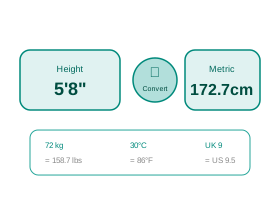
Unit Conversion Updates in real-time Input 5 ft 8 in Imperial Output 172.72 cm Metric Always round only after the full conversion is complete — early rounding causes measurement errors.
tips_and_updates

Real-Life Guide to Using the Height Converter

cm to feet/inches and back. Use the examples and checks below to turn the number into a practical decision.

When this calculator is useful

Useful when filling out a visa, passport, gym membership, or matrimonial profile form that asks for height in feet/inches but you only know your height in centimetres from an Indian hospital or school record, or the reverse.

For most people, the best way to use the Height Converter is to try the real case first, then change one input at a time. That makes the trade-off visible. For example, with a loan calculator you can change tenure while keeping the same rate; with an investment calculator you can change return assumption while keeping the same monthly contribution; with a health, education or measurement calculator you can check how much one input changes the final category.

The result should answer a practical question: Can I afford this? How much should I save? Is this score enough? Is this measurement within range? What is the safer or cheaper option? If the output does not answer the decision clearly, adjust the inputs until the scenario matches your real situation.

lightbulb Real-Life Example
Filling a US visa form: Rohan measured 170 cm at a clinic and needs to enter his height in feet and inches on a DS-160 visa application.
1170 cm ÷ 2.54 = 66.93 inches total; 66.93 ÷ 12 = 5 with a remainder, giving 5 feet 6.93 inches, which rounds to 5 feet 7 inches for the form.
2Now change one input, such as rate, time, quantity, unit or score, and compare the new result with the first one.
Always convert to total inches first, then divide by 12 to split into feet and inches — converting feet and inches separately from a decimal often introduces rounding mistakes.

Practical Advice

Use the Height Converter as a planning tool, not just a number generator. Write down the inputs you used, because the final answer is meaningful only when you remember the assumptions behind it.

If the decision affects money, health, tax, safety, academics or legal compliance, keep a second check ready. That second check may be a bank quote, payslip, official rule, prescription, site measurement, mark sheet or invoice.

Common Mistakes

  • Reading "5.6 feet" from a decimal converter as 5 feet 6 inches, when 5.6 feet actually means 5 feet and 0.6×12 = 7.2 inches — a nearly 1-inch error that matters on official forms.
  • Rounding 162 cm to "about 5 foot 4" and writing that on a document instead of the precise 5 feet 3.8 inches, which can cause mismatches with a measured height on ID verification.
  • Confusing height measured with shoes on versus barefoot — many home measurements include shoe sole height (1-3 cm), leading to a converted figure that's taller than the true barefoot height.
  • Applying the conversion inconsistently — converting a child's height at a doctor's visit in cm but comparing it to a growth chart calibrated in inches without converting both to the same unit first.
  • Forgetting that "5'6\"" notation uses feet and inches, not feet and a decimal — mistyping 5.6 into a field expecting 5 feet 6 inches produces a different, taller height than intended.

How to Interpret Results

Read the output as feet and whole inches (e.g. "5 ft 7 in"), and if a form insists on a single decimal number in feet, convert the inches portion by dividing by 12 rather than just tacking the inch number after the decimal point.

A good interpretation looks at both the main result and the supporting values. If a page shows totals, ratios, categories, schedules or warnings, read those together instead of focusing only on the biggest number.

quiz

Height Converter FAQs

Useful answers for interpreting the output, avoiding mistakes and using the result responsibly.

What formula does this height converter use?
It converts centimetres to inches by dividing by 2.54 (since 1 inch = 2.54 cm exactly), then splits the total inches into feet (dividing by 12) and remaining inches. Converting the other way multiplies feet by 12, adds the inches, then multiplies the total by 2.54.
Why do Indian hospital records use cm while US forms ask for feet and inches?
India, like most of the world, uses the metric system for medical and official records, while the US retains imperial units for everyday measurements including height. This calculator bridges that gap for visa applications, US college forms, and similar documents.
Is there a standard "average height" I can compare my result to?
Average adult male height in India is roughly 165-166 cm (about 5 ft 5 in) and average adult female height is roughly 152-153 cm (about 5 ft 0 in), based on national health survey data, though these figures shift slowly across birth cohorts. Use them as a rough benchmark, not a precise standard.
Why does my height look different when measured in the morning versus evening?
Spinal discs compress slightly under gravity through the day, so most people are genuinely 1-2 cm shorter by evening than right after waking up. For consistency on official documents, measure in the morning if possible.
Does this calculator round up or down?
It shows the precise decimal inch value alongside a whole-inch rounded figure so you can choose based on context — use the precise value for medical or technical records, and the rounded whole-inch figure for casual references like a dating profile.
How do I convert height for a child growth chart that uses percentiles?
First convert the child's measured height to whichever unit (cm or inches) matches the specific growth chart you're using — WHO charts use cm, some US pediatric charts use inches — since plotting the wrong unit onto a percentile curve gives a meaningless result.
What's the difference between "5 feet 6" and "5.6 feet" that people confuse?
"5 feet 6 inches" means 5 feet plus 6 inches (66 total inches = 167.6 cm), while "5.6 feet" means 5 feet plus 0.6 of a foot, i.e. 5 feet 7.2 inches (67.2 total inches = 170.7 cm). These differ by over an inch, so never substitute one notation for the other.
Can this be used for converting a toddler's height, which is sometimes measured in cm only?
Yes, the same cm-to-inches formula applies regardless of age; just note that pediatric measurements below 2 years are usually recumbent (lying down) length rather than standing height, which can differ slightly from standing measurements taken later.

Height Unit Systems

Height is measured in different units depending on the country. India, like most of the world, officially uses the metric system — centimetres (cm) or metres (m). However, feet and inches remain in common use for everyday height description in India, often alongside metric.

The US and UK primarily use feet and inches. Medical records in India use cm. Clothing and fitness apps may use either. This converter handles all combinations accurately.

lightbulb Conversion Facts
Key conversion factors:
11 inch = 2.54 cm exactly (defined)
21 foot = 12 inches = 30.48 cm
35′7″ = 67 inches × 2.54 = 170.18 cm
✓ Average Indian male: ~165 cm (5′5″)

quizFrequently Asked Questions

How do I convert cm to feet and inches manually?
Step 1: Divide cm by 2.54 to get total inches. Step 2: Divide total inches by 12 — the whole number is feet. Step 3: The remainder is inches. Example: 175 cm ÷ 2.54 = 68.90 inches total. 68.90 ÷ 12 = 5 feet remainder 8.90 inches. So 175 cm = 5 feet 8.9 inches (5′8.9″). Quick mental check: 30 cm ≈ 1 foot, so 180 cm ≈ 6 feet.
What is 5 feet 7 inches in cm?
5 feet 7 inches = (5 × 12 + 7) inches = 67 inches × 2.54 cm/inch = 170.18 cm. Rounded: 170.2 cm. This is a commonly asked height — it's approximately average male height in India. For quick reference: 5′0″ = 152.4 cm, 5′5″ = 165.1 cm, 5′7″ = 170.2 cm, 5′10″ = 177.8 cm, 6′0″ = 182.9 cm.
Why do some countries use feet/inches while others use centimetres?
The US, Liberia, and Myanmar are the only countries that have not officially adopted the metric system (SI). The UK officially uses metric but feet/inches remain in common cultural use for height and weight. India adopted the metric system in 1956 — all official measurements use SI units. However, colloquial height expressions in Indian English ("he's 5'10"") often use feet and inches, particularly among older generations and in matrimonial contexts. Medical, sports, and scientific contexts in India always use cm/kg.
keyboard_arrow_up