
Ohm's Law Calculator
Solve for voltage, current, resistance, or power — enter any two values
Real-Life Guide to Using the Ohm's Law Calculator
Voltage, current, resistance. Use the examples and checks below to turn the number into a practical decision.
When this calculator is useful
Used when wiring or troubleshooting a circuit — sizing a current-limiting resistor, checking how much current a component will draw, or working out an unknown resistance from a measured voltage and current.
For most people, the best way to use the Ohm's Law Calculator is to try the real case first, then change one input at a time. That makes the trade-off visible. For example, with a loan calculator you can change tenure while keeping the same rate; with an investment calculator you can change return assumption while keeping the same monthly contribution; with a health, education or measurement calculator you can check how much one input changes the final category.
The result should answer a practical question: Can I afford this? How much should I save? Is this score enough? Is this measurement within range? What is the safer or cheaper option? If the output does not answer the decision clearly, adjust the inputs until the scenario matches your real situation.
Practical Advice
Use the Ohm's Law Calculator as a planning tool, not just a number generator. Write down the inputs you used, because the final answer is meaningful only when you remember the assumptions behind it.
If the decision affects money, health, tax, safety, academics or legal compliance, keep a second check ready. That second check may be a bank quote, payslip, official rule, prescription, site measurement, mark sheet or invoice.
Common Mistakes
- Leaving resistance in kilo-ohms while expecting the current answer in amps — a 4.7 kΩ resistor entered as '4.7' instead of '4700' understates the resistance by 1000x.
- Confusing V = IR with the power formula P = IV, and typing a wattage value into the voltage field.
- Ignoring the internal resistance of a battery or source, which matters when precise current values are needed for sensitive components.
- Applying the calculator's simple V = IR relationship to an AC circuit with reactance, where impedance rather than plain resistance governs current flow.
- Losing track of which two of the three values (V, I, R) are actually known, and solving for the wrong quantity.
How to Interpret Results
Compare the computed current against the safe operating current of your component — for instance, a standard LED is typically rated around 20 mA, so a result near or above that signals you need a larger resistor.
A good interpretation looks at both the main result and the supporting values. If a page shows totals, ratios, categories, schedules or warnings, read those together instead of focusing only on the biggest number.
Ohm's Law Calculator FAQs
Useful answers for interpreting the output, avoiding mistakes and using the result responsibly.
Ohm's Law Explained
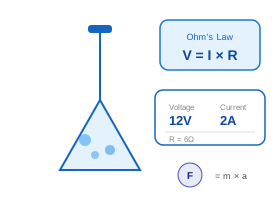
Ohm's Law states that the current through a conductor is directly proportional to the voltage across it and inversely proportional to the resistance: V = I × R. It's the foundational relationship in electronics, named after German physicist Georg Ohm (1827).
The power formula P = V × I extends Ohm's Law. Combining with V = IR gives P = I²R (for heating calculations, like how much heat a resistor dissipates) and P = V²/R (for power loss in wires). These are used in circuit design, electrical safety, and energy efficiency calculations.