
local_gas_station

Fuel Cost Calculator

Estimate petrol or diesel cost for any trip based on distance, mileage and fuel price
edit_calendar Last updated: Jul 22, 2026 | verified Reviewed by Calkulator Team | timer 2 min read
Transport illustration
Transport

Calculate fuel cost for any road trip or daily commute

A 500 km trip in a car giving 15 km/l needs about 33 litres of fuel. At ₹105/litre, that is ₹3,500 one way. Factor in return trips, AC usage, and city traffic to get a realistic budget before you hit the road.

tips_and_updates Highway driving gives 20-30% better mileage than city driving — plan fuel stops accordingly.
Trip Details
Distance (km)
km
Fuel Efficiency (km/L)
km/L
Fuel Price (₹/L)
Number of Trips
×
Enter 2 for a round trip, or more for multiple trips
Quick Reference — Fuel Prices (approx.)
Petrol (Delhi): ~₹94–96/L
Diesel (Delhi): ~₹87–89/L
CNG (Delhi): ~₹74–76/kg
Prices vary by city and date. Check local fuel station for current rates.
Total Fuel Cost
Fuel needed:
Cost per km
Total Distance
Trips
Fuel Efficiency
Fuel Price
insights
Live Result Illustration
Visual summary — updates instantly as you enter values above
LIVE
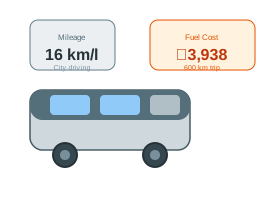
Journey & Fuel Cost Updates in real-time A B 600 km Fuel Required 37.5 L Fuel Cost ₹3,938 Fuel Efficiency 16 km/L
tips_and_updates

Real-Life Guide to Using the Fuel Cost Calculator

Trip fuel cost from distance. Use the examples and checks below to turn the number into a practical decision.

When this calculator is useful

Useful for planning a road trip budget, comparing the cost of driving versus taking a train or flight, or working out a fair fuel-cost split when carpooling with friends or colleagues.

For most people, the best way to use the Fuel Cost Calculator is to try the real case first, then change one input at a time. That makes the trade-off visible. For example, with a loan calculator you can change tenure while keeping the same rate; with an investment calculator you can change return assumption while keeping the same monthly contribution; with a health, education or measurement calculator you can check how much one input changes the final category.

The result should answer a practical question: Can I afford this? How much should I save? Is this score enough? Is this measurement within range? What is the safer or cheaper option? If the output does not answer the decision clearly, adjust the inputs until the scenario matches your real situation.

lightbulb Real-Life Example
Budgeting a highway road trip: A family is driving from Mumbai to Goa, a distance of about 590 km, in a car with a real-world mileage of 15 km/l, with petrol priced at roughly ₹100/litre.
1Fuel needed = 590 / 15 ≈ 39.3 litres. Cost = 39.3 x 100 ≈ ₹3,933 one-way. For a round trip, double this to approximately ₹7,867 total fuel cost.
2Now change one input, such as rate, time, quantity, unit or score, and compare the new result with the first one.
Always double the one-way figure for a round trip and round the fuel cost up slightly, since return-leg traffic near city entry points often drags mileage down compared to the open highway outbound leg.

Practical Advice

Use the Fuel Cost Calculator as a planning tool, not just a number generator. Write down the inputs you used, because the final answer is meaningful only when you remember the assumptions behind it.

If the decision affects money, health, tax, safety, academics or legal compliance, keep a second check ready. That second check may be a bank quote, payslip, official rule, prescription, site measurement, mark sheet or invoice.

Common Mistakes

  • Using the car's claimed ARAI mileage figure instead of its real-world mileage, which is typically 15-25% lower in actual city or highway driving conditions.
  • Forgetting that fuel prices vary noticeably by state due to differing VAT rates, so a Delhi price entered for a trip through Rajasthan or Maharashtra can misstate the real cost.
  • Ignoring the return leg of the trip and only calculating one-way distance and cost, halving the actual budget needed.
  • Not adjusting mileage for a fully loaded car with luggage and passengers versus the single-driver mileage figure typically used as a reference.
  • Using highway mileage for a trip that's mostly city or hill driving, which can overstate fuel efficiency by several km/l.

How to Interpret Results

The result multiplies your distance by fuel consumed per km and the price per litre to give total trip cost — treat it as a reasonable estimate and add a 10-15% buffer for traffic, AC usage, or route detours that lower real-world mileage below the figure you entered.

A good interpretation looks at both the main result and the supporting values. If a page shows totals, ratios, categories, schedules or warnings, read those together instead of focusing only on the biggest number.

quiz

Fuel Cost Calculator FAQs

Useful answers for interpreting the output, avoiding mistakes and using the result responsibly.

What does the Fuel Cost Calculator work out?
It takes your trip distance, your vehicle's fuel efficiency in km per litre, and the current fuel price per litre, then multiplies these together to estimate the total fuel cost for the journey.
Should I use my car's ARAI-certified mileage or its real-world mileage?
Use real-world mileage if you know it from your own driving experience, since ARAI figures are measured under controlled lab conditions and typically run 15-25% higher than what you'll actually get in city traffic or with the AC running continuously on a highway trip.
My actual fuel spend on the trip was higher than the calculator estimated — why?
Real trips include idling in traffic, AC load, a fully loaded car with passengers and luggage, and route detours, all of which lower effective mileage below a clean, single-driver reference figure, so treat the calculator's number as a floor estimate and budget 10-15% extra.
How do I handle a road trip that crosses multiple states with different fuel prices?
For a rough estimate, use the average of the fuel prices at your origin and destination states, or if you know you'll fill up mostly in one particular state, use that state's price since VAT differences between states can shift the per-litre price by ₹5-10 or more.
Does this calculator help me compare driving versus flying or taking a train?
It only calculates fuel cost, so for a fair comparison you should separately add toll charges, parking, and driver fatigue/time cost to the fuel figure, then compare that total against train or flight ticket prices for an apples-to-apples decision.
How should I split fuel cost fairly when carpooling?
Calculate the total trip fuel cost using this tool, then divide it evenly by the number of people sharing the ride (including the driver, unless the driver is exempted by group agreement), which is generally fairer than one person estimating and rounding informally.
What mileage figure should I use for a trip that's mixed city and highway driving?
Use a blended estimate weighted toward whichever driving condition dominates your route — for example, if 70% of the trip is highway and 30% is city, lean your mileage figure closer to your car's highway mileage but shade it down slightly to account for the city portion.
What should I do with the fuel cost estimate before finalising a travel budget?
Add estimated toll costs, parking fees, and a contingency buffer of 10-15% for unexpected detours or traffic-heavy stretches, since the fuel figure alone only covers one part of the total on-road cost of a trip.

What is a Fuel Cost Calculator?

A fuel cost calculator helps you estimate the petrol or diesel expense for any road trip or daily commute. By entering the distance, your vehicle's mileage (fuel efficiency in km/L), and the current fuel price, you can instantly know how much you'll spend on fuel.

This is useful for planning road trips, budgeting monthly car expenses, comparing fuel cost of different vehicles, and calculating reimbursement amounts for official travel.

lightbulb Example Calculation
Scenario: Priya is driving from Delhi to Agra (230 km) in her car that gives 16 km/L. Petrol price is ₹95/L.
1Fuel needed = 230 ÷ 16 = 14.38 L
2Fuel cost = 14.38 × ₹95 = ₹1,366
3Round trip (×2): ₹2,732 total
✓ Cost per km = ₹5.94/km

help_outlineHow to Use the Fuel Cost Calculator

  1. Enter the Distance — total one-way distance of your trip in kilometres.
  2. Enter your vehicle's Fuel Efficiency in km/L (check your car manual or use our Mileage Calculator to find yours).
  3. Enter the current Fuel Price in ₹ per litre for petrol or diesel (check local fuel station or government portal).
  4. Set Number of Trips — enter 2 for a round trip, or higher for multiple journeys.
  5. Results update instantly showing total cost, fuel needed, and cost per km.

Tips to Reduce Fuel Cost

  • Maintain correct tyre pressure — under-inflation increases fuel consumption by up to 3%
  • Drive at steady speeds between 60–80 km/h on highways — optimal fuel efficiency zone for most cars
  • Avoid unnecessary idling — idling for 10 minutes burns ~0.4–0.8 L of fuel for no movement
  • Service your car regularly — a clogged air filter can reduce fuel efficiency by 10%
  • Use cruise control on long highway stretches to maintain consistent speed
  • Plan routes to avoid peak traffic — stop-and-go driving is the most fuel-inefficient pattern

Key Terms

Fuel Efficiency (km/L)
Also called mileage — kilometres your vehicle travels on one litre of fuel. Typical petrol cars: 12–20 km/L; SUVs: 10–15 km/L; motorcycles: 40–60 km/L.
Cost per km
Total fuel cost divided by total distance. Useful for comparing travel modes (car vs train vs bus) and calculating official travel reimbursements.
Round Trip
Enter 2 in the "Number of Trips" field to calculate fuel for going and returning the same distance.
Fuel Grades
Regular petrol (87 octane) vs premium (91–95 octane) — most Indian passenger cars run fine on regular petrol. Diesel engines are typically 15–20% more fuel efficient than equivalent petrol engines.

quizFrequently Asked Questions

How do I find my car's fuel efficiency (mileage)?
Fill your tank completely. Drive normally until you've used a significant amount of fuel (ideally 200–400 km). Fill up again, note the litres added and the distance driven. Mileage = Distance ÷ Fuel added. For example, if you drove 300 km and refuelled with 22 L: mileage = 300 ÷ 22 = 13.6 km/L. You can also use our Mileage Calculator for this. Manufacturer's quoted mileage is often 15–25% higher than real-world figures because testing is done under ideal controlled conditions.
Why does actual fuel cost differ from the calculator's estimate?
Real-world mileage varies due to: traffic conditions (city driving reduces mileage by 20–30% vs highway), AC usage (reduces efficiency by 5–15%), vehicle load (extra passengers and luggage), road gradient (hills increase fuel consumption), tyre pressure, engine health, and driving style (aggressive acceleration is the biggest factor). The calculator uses your entered mileage — for best accuracy, use your real-world measured mileage rather than the manufacturer's claimed figure.
How do I calculate fuel cost for CNG vehicles?
CNG mileage is measured in km/kg (not km/L). Enter your car's km/kg figure in the "Fuel Efficiency" field and use the current CNG price per kg in the "Fuel Price" field. For example, if your CNG car gives 28 km/kg and CNG costs ₹75/kg: a 300 km trip needs 300 ÷ 28 = 10.7 kg × ₹75 = ₹803. CNG vehicles typically have 40–50% lower fuel cost compared to petrol for the same distance.
Can I use this calculator for two-wheelers?
Yes — just enter your bike's mileage (typically 40–60 km/L for 100–150cc bikes, 25–40 km/L for 200–400cc bikes) and petrol price. Two-wheelers are significantly more fuel-efficient than cars: a bike averaging 50 km/L costs only ₹1.88/km at ₹94/L petrol, versus a car at 15 km/L costing ₹6.27/km — over 3× cheaper per kilometre.
How do I calculate fuel reimbursement for office travel?
Most companies reimburse at a fixed rate per km (e.g., ₹5–8/km for two-wheelers, ₹8–15/km for cars) rather than actual fuel cost. However, if your employer reimburses actual fuel cost, use this calculator: enter the distance, your vehicle's actual mileage, and the fuel price on the date of travel. The total cost shown is your reimbursable amount. Keep fuel receipts as supporting documentation.
keyboard_arrow_up