
account_balance_walletInput Tax Credit (ITC) Calculator

Calculate net ITC available from purchases — with eligibility filter, reversals & closing balance
edit_calendar Last updated: Jul 22, 2026 | verified Reviewed by Calkulator Team | timer 2 min read
Tax illustration
Tax

Reconcile your Input Tax Credit before filing returns

ITC lets you offset GST paid on purchases against GST collected on sales. But blocked credits (personal use, exempt supplies) and reversals reduce your eligible ITC. This calculator helps you compute the net ITC before filing.

tips_and_updates Always reconcile your ITC with GSTR-2B before claiming — mismatches trigger notices from the GST portal.

Opening Balance & Reversals

currency_rupee Carried forward from previous period
currency_rupee Ineligible / blocked credit to reverse

Purchase Invoices

ITC Formula

Input GST = Invoice Value — GST Rate / (100 + GST Rate)

Net ITC = Eligible ITC - Reversal

Closing ITC = Opening + Net ITC

Rule 17(5) Blocked: Cars, food, health insurance, club membership, works contract (for personal use)

Net ITC Available
After reversal
Closing ITC Balance
Carry forward
Total Purchase Value
All invoices
Total Input GST
GST paid on purchases
ITC Eligible Amount
From eligible invoices
ITC Reversal
Blocked/ineligible
Opening ITC
Carried forward
Ineligible GST
From blocked invoices

Invoice Breakup

SupplierValueGST %ITCEligible
insights
Live Result Illustration
Visual summary — updates instantly as you enter values above
LIVE
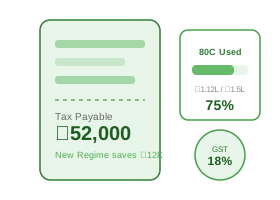
Salary & Tax Breakdown Updates in real-time Gross Income ₹10,00,000 Income Tax ₹2,00,000 20% PF + Deductions ₹83,000 Net Take-Home ₹7,17,000 71.7% Tip: Max out Section 80C (₹1.5L), HRA, and NPS contributions to legally reduce your tax outgo.
tips_and_updates

Real-Life Guide to Using the ITC Calculator

Input Tax Credit reconciliation. Use the examples and checks below to turn the number into a practical decision.

When this calculator is useful

Businesses reconciling their monthly GST filing use this to check how much Input Tax Credit they can actually claim after comparing purchases recorded in their books against what suppliers have reported in GSTR-2B, and after excluding any blocked credits.

For most people, the best way to use the ITC Calculator is to try the real case first, then change one input at a time. That makes the trade-off visible. For example, with a loan calculator you can change tenure while keeping the same rate; with an investment calculator you can change return assumption while keeping the same monthly contribution; with a health, education or measurement calculator you can check how much one input changes the final category.

The result should answer a practical question: Can I afford this? How much should I save? Is this score enough? Is this measurement within range? What is the safer or cheaper option? If the output does not answer the decision clearly, adjust the inputs until the scenario matches your real situation.

lightbulb Real-Life Example
Trader reconciling monthly purchases: A trader's purchase register shows ₹50,000 of GST paid on inputs for the month, but GSTR-2B reflects only ₹42,000 because two suppliers have not yet filed their GSTR-1, and ₹3,000 of the ₹42,000 relates to a blocked category (staff refreshments).
1Eligible ITC for the month is ₹42,000 − ₹3,000 = ₹39,000, not the full ₹50,000 in the purchase register; the ₹8,000 gap from unfiled supplier returns can only be claimed once those suppliers file and it appears in a later GSTR-2B.
2Now change one input, such as rate, time, quantity, unit or score, and compare the new result with the first one.
ITC eligibility depends on what your suppliers have actually reported, not just what your own purchase invoices say, so vendor compliance directly affects your available credit.

Practical Advice

Use the ITC Calculator as a planning tool, not just a number generator. Write down the inputs you used, because the final answer is meaningful only when you remember the assumptions behind it.

If the decision affects money, health, tax, safety, academics or legal compliance, keep a second check ready. That second check may be a bank quote, payslip, official rule, prescription, site measurement, mark sheet or invoice.

Common Mistakes

  • Claiming ITC on purchases that appear in the books but are missing from GSTR-2B because the supplier hasn't filed their GSTR-1, since current rules restrict ITC largely to what is reflected in GSTR-2B
  • Claiming ITC on blocked categories under Section 17(5), like motor vehicles for personal use, food and beverages, or club memberships, which are specifically disallowed regardless of a valid tax invoice
  • Not reversing proportionate ITC under Rule 42/43 when a business makes both taxable and exempt supplies, and common input services are used for both
  • Missing the time limit for claiming ITC on an invoice — generally by the earlier of the due date of filing return for November of the following financial year or the date of filing the annual return
  • Forgetting to reverse ITC already claimed on goods that were later used for personal consumption, lost, stolen, or given away as free samples

How to Interpret Results

The output shows your eligible ITC after matching books against GSTR-2B and excluding blocked/reversed items — this is the credit you can actually set off against your output tax liability, not simply the GST shown on every purchase invoice you hold.

A good interpretation looks at both the main result and the supporting values. If a page shows totals, ratios, categories, schedules or warnings, read those together instead of focusing only on the biggest number.

quiz

ITC Calculator FAQs

Useful answers for interpreting the output, avoiding mistakes and using the result responsibly.

What does this ITC calculator actually reconcile?
It compares the GST shown as paid on your purchases (from your books or purchase register) against what your suppliers have reported in GSTR-2B, then subtracts any blocked credits under Section 17(5) and applicable proportionate reversals, to arrive at the ITC you can legitimately claim for the period.
Why is my eligible ITC lower than the total GST on my purchase invoices?
This usually happens because a supplier has not yet filed their GSTR-1 for the period so the invoice doesn't appear in your GSTR-2B, or because some of your purchases fall under blocked credit categories that are disallowed by law even with a valid invoice.
What are the most common blocked ITC categories businesses miss?
Common blocked items under Section 17(5) include motor vehicles (with some exceptions for specific business uses), food and beverages, outdoor catering, club and gym memberships, works contract services for construction of immovable property (with exceptions), and goods lost, stolen, or given as free samples or gifts.
What happens if I claim ITC that later turns out to be ineligible?
If ITC is wrongly claimed and utilized, it needs to be reversed along with interest from the date it was availed, and in cases of deliberate wrong claims, penalty can also apply; routine mismatches are usually resolved by reversing the credit and reclaiming it later once the supplier files correctly.
Is there a deadline for claiming ITC on an invoice?
Yes, ITC on an invoice generally must be claimed by the earlier of the due date for filing the GST return for November following the end of that financial year, or the date of filing the annual return for that year — after this, the credit typically lapses even if it was genuinely eligible.
How does this calculator handle a business that makes both taxable and exempt supplies?
Under Rule 42 (for inputs and input services) and Rule 43 (for capital goods), ITC on common inputs used for both taxable and exempt supplies must be proportionately reversed based on the ratio of exempt turnover to total turnover — this calculator needs your exempt and taxable turnover figures to compute that reversal accurately.
My GSTR-2B and GSTR-2A show different figures — which does the calculator rely on?
Current ITC claim rules are based on GSTR-2B, an auto-generated, static statement for the period, rather than GSTR-2A, which is dynamic and can keep changing as suppliers amend past filings — this calculator should be reconciling against GSTR-2B for determining eligible credit for a given month.
What should I do about purchases missing from GSTR-2B this month?
Follow up with the supplier to confirm they have filed or will file their GSTR-1 for that invoice, hold off claiming that specific credit until it reflects in a GSTR-2B, and claim it in whichever later month it appears, keeping in mind the overall time limit for claiming ITC on that invoice.

What is Input Tax Credit (ITC)?

Input Tax Credit (ITC) is the GST paid on business purchases that you can deduct from the GST you owe on your sales. It prevents the cascading effect of tax-on-tax. A registered dealer who buys goods worth ₹1 Lakh + 18% GST can claim the ₹18,000 GST paid as credit against their output GST.

Not all purchases qualify for ITC — blocked credits under Rule 17(5) include motor vehicles (for personal use), food and beverages, club memberships, and certain construction expenses. ITC must be claimed within the time limit (annual return of the relevant year) and matched with supplier filings in GSTR-2B.

lightbulb Example Calculation
Scenario: Sharma Enterprises (restaurant equipment supplier in Chennai) — monthly purchases: Raw steel ₹2,00,000 + 18% GST, Packaging ₹50,000 + 12% GST, Office stationery ₹10,000 + 18% GST. Output GST on sales: ₹85,000
1ITC on steel = ₹2,00,000 — 18% = ₹36,000 | ITC on packaging = ₹50,000 — 12% = ₹6,000
2ITC on stationery = ₹10,000 — 18% = ₹1,800 | Total ITC available = ₹36,000 + ₹6,000 + ₹1,800 = ₹43,800
3GST payable = Output GST - ITC = ₹85,000 - ₹43,800 = ₹41,200 (net GST to government)
✓ Result: Sharma Enterprises needs to deposit only ₹41,200 as GST — saved ₹43,800 via Input Tax Credit on business purchases.

help_outlineHow to Use the ITC Calculator

  1. Enter the ITC Opening Balance — the credit balance carried forward from the previous GSTR-3B filing (from your GST portal's Electronic Credit Ledger).
  2. Enter any ITC Reversal amount — credits that must be reversed due to ineligible purchases, partial use for exempt supplies, or blocked credits under Rule 17(5).
  3. Add each Purchase Invoice: supplier name, invoice value (GST inclusive), and GST rate. Uncheck "ITC Eligible" for invoices where ITC is blocked (e.g., personal car, food, health insurance).
  4. Click Add Invoice Row to add multiple suppliers in the same period. Each row's ITC is computed from the GST component of the invoice value.
  5. Click Calculate ITC to see eligible ITC, reversal, net ITC available, and closing balance — which can be used to offset against output GST in GSTR-3B.

Benefits

  • Accurately calculates net ITC after applying Rule 17(5) blocked credit restrictions — avoids future reversals and GST notices
  • Tracks opening and closing ITC balance across periods — essential for GSTR-3B reconciliation
  • Mix eligible and ineligible invoices in one calculation — auto-separates ITC amounts
  • Shows net GST cash payable: Output GST - Net ITC — plan cash outflow before GSTR-3B due date
  • Identifies blocked credit purchases upfront — prevents claiming credits that must later be reversed with interest

Key Terms

ITC (Input Tax Credit)
GST paid on business purchases that can be offset against GST collected on your sales — reducing net tax deposited to government. Available only on GSTN-registered supplier invoices reflected in GSTR-2B.
ITC Reversal
Credits that must be returned: used for exempt supplies, personal consumption, supplier cancelled invoices, or any blocked credit under Rule 17(5). Reversal with interest (18% p.a.) if taken wrongly.
Rule 17(5) — Blocked Credits
ITC NOT available on: motor vehicles (for personal use), food/beverages, outdoor catering, club memberships, beauty treatment, health insurance, works contract for immovable property, and goods/services for personal consumption.
GSTR-2B
Auto-populated ITC statement generated on the 14th of each month — shows ITC available based on supplier GSTR-1 filings. ITC can only be claimed for invoices appearing in GSTR-2B (Rule 36(4)).
Electronic Credit Ledger
Your GST portal account showing cumulative ITC balance available. Separate from the Cash Ledger (cash deposited for tax payment). ITC from Credit Ledger is utilized before cash payment.

quizFrequently Asked Questions

What purchases are blocked from ITC under Rule 17(5)?
Rule 17(5) blocks ITC on: (1) Motor vehicles with seating capacity = 13 persons (unless used for transportation of passengers, goods, or for resale/training). Trucks and buses qualify for ITC. (2) Food and beverages, outdoor catering, beauty treatment, health services, cosmetic surgery. (3) Membership of clubs, fitness centres, health clubs. (4) Travel benefits like Leave Travel Allowance or home travel concession to employees. (5) Works contract services for construction of immovable property (except plant and machinery). (6) Goods or services for personal use (not business). Health insurance paid for employees is also blocked — except where the employer is required by law to provide it (factories with statutory health provisions).
Can I claim ITC if my supplier has not filed GSTR-1?
No — as per Rule 36(4) and Section 16(2)(aa), ITC can only be claimed to the extent the invoice appears in your GSTR-2B (auto-populated from supplier's GSTR-1 filing). If your supplier fails to file GSTR-1, the invoice won't appear in GSTR-2B and you cannot claim that ITC. This has become a major pain point for businesses dealing with non-compliant suppliers. Best practice: (1) Check GSTR-2B on the 14th of each month before filing GSTR-3B; (2) Follow up with suppliers to file on time; (3) Include a GST compliance clause in vendor agreements; (4) Prefer suppliers with 100% GSTR-1 filing history.
What is the time limit for claiming ITC under GST?
ITC for a financial year must be claimed by the earlier of: (1) November 30th of the following year (i.e., GSTR-3B for October filed by November 30th); or (2) The date of filing the annual return GSTR-9 for that year. Example: ITC on an invoice from FY 2024-25 must be claimed in GSTR-3B by November 30, 2025, or the GSTR-9 filing date — whichever is earlier. ITC not claimed within this window is permanently lost. Always reconcile purchase register with GSTR-2B monthly to ensure no ITC is left unclaimed due to timing or supplier filing gaps.
How does ITC reversal work when I use purchases for both taxable and exempt supplies?
If a business makes both taxable and exempt supplies (e.g., a company selling GST-applicable products and also providing exempt financial services), ITC on common inputs must be reversed proportionally — using Rule 42 and 43. Formula: Reversal = Total ITC — (Exempt Supply Value / Total Turnover). This is calculated annually and adjusted monthly on a provisional basis. For example: if 20% of turnover is from exempt supplies, 20% of common ITC must be reversed. ITC exclusively for exempt supplies must be fully reversed. ITC exclusively for taxable supplies is fully eligible. Consult a GST consultant for accurate annual reversal computation.
Can I claim ITC on health insurance premiums paid for employees?
Generally No — health insurance premiums are blocked under Rule 17(5)(b) as a non-eligible expense. However, there is an exception: if the employer is legally required to provide health insurance to employees under any law (e.g., factories under the Employees' State Insurance Act, or companies mandated by contract to provide health cover), ITC on that statutory component is eligible. For most companies that voluntarily provide group health insurance as an employee benefit, the GST paid (18%) on the premium cannot be claimed as ITC. This is a significant cost — an ₹20 Lakh group premium attracts ₹3.6 Lakh GST that becomes a sunk cost.
keyboard_arrow_up